

I bought The Adventure Challenge Couples Edition in a moment of mild desperation. Walt and I have been married since June 1986, and somewhere around year thirty our Friday nights had flattened into the same two hours: supper, the evening news, one of us asleep in the chair by nine. He says he does not need anything, and he means it, which makes him the hardest person in Asheville to buy for. A book of fifty scratch-off dates looked like the sort of thing that either rescues a couple from terminal routine or ends up in the drawer with the fondue set.
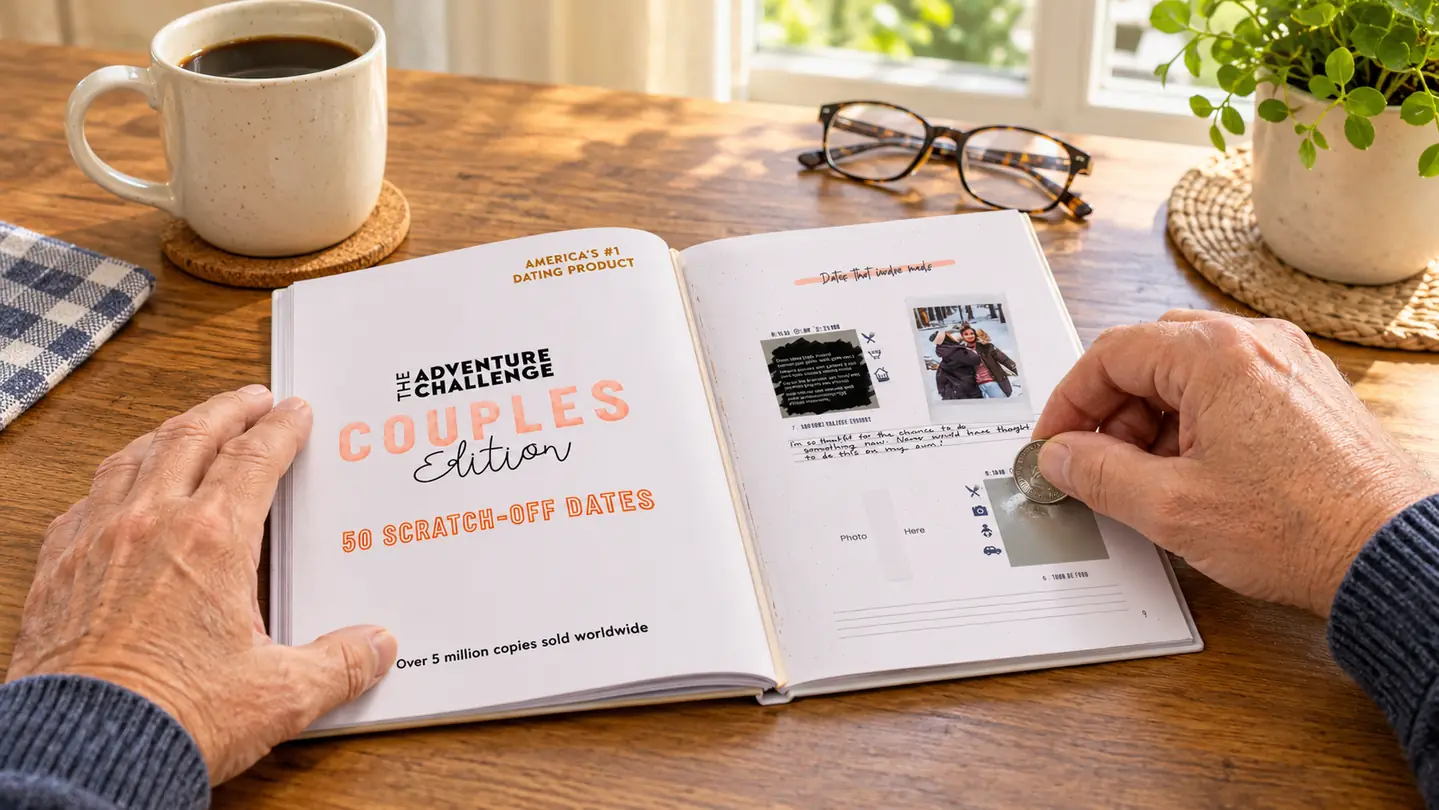
Here is the honest version, the one I would give my daughter Lauren if she asked me straight out. The Adventure Challenge is not a subscription, not an app, and not a repair kit for anything that is genuinely broken between two people. What it is: a small hardcover book, 10.75 by 7.15 by 1.2 inches and 1.03 pounds, with fifty covered panels inside. You do not know what the date is until you scratch the foil off. That is the whole mechanism, and it works better than it has any right to.
I have used this book across a full year now, and I bought a second copy for my son Ben and his wife. So this is not a first-impression piece written off a product listing. I have scratched panels, talked Walt into a few things he grumbled about, skipped others entirely, and watched which ones we actually finished rather than merely agreed to. That is the review I want to read when I am the one deciding, so that is the review I wrote.
The Quick Verdict
Worth buying for a couple stuck in a rut who will actually do the dates. Not worth buying if one of you needs the plan in advance, because the entire book is built on not knowing.
Amazon Check Today's Price →Fifty dates, none of which you have to invent yourself
A hardcover book of scratch-off ideas, each one printed with a rough time range and cost range so you can pick what fits the week you are actually having. Check the current rating and today's price on Amazon.
Amazon Check Today's Price on Amazon →How We've Used It
The mechanic is simple and I want to describe it properly, because most descriptions of this book stay vague. Each date gets a page. At the top is a foil panel, about the size of a large postage stamp, with the name of the date hidden underneath. You cannot read it through the foil. One of you scratches it with a coin while the other watches, and then you either do the thing or you do not. Under the panel there is guidance about roughly how long it takes and roughly what it costs to pull off, and that guidance is printed plainly, before you have committed to anything.
Our pattern settled in fast. Walt scratches, because he has better fingernails for it and takes a boyish pleasure in being the one to reveal it. I read over his shoulder. If the panel calls for a Saturday and we only have a Wednesday, we fold the corner of the page and come back to it. That folded corner is the closest thing this book has to a to-do list, and after a year there are a good many of them.
What surprised me is the range. The dates are not all dinner related, which was my fear going in. Some are things you do at the kitchen table in an hour. Some want a car, a free afternoon, and decent weather. At least one wanted other people, which is a different kind of commitment entirely when you are sixty three and your friends are also sixty three and also busy. The spread is a strength, but it does mean this is not a Friday-night machine. It is a planning tool that occasionally lands on a Friday night.
I should say what we did with the dates we did not want to do. We did not force them. Five or six panels over the year, we read the reveal and knew immediately we were not going to do that one. Walt called it a no, I agreed, and we did something else that week instead. I do not count that as the book failing. Any collection of fifty ideas is going to hold a few that do not fit two particular people, and the honest expectation going in is that you will do somewhere around forty of them. Fifteen years ago I would have been irritated by that arithmetic. At sixty three I think forty good evenings out of one book is a fine return.
What Nobody Tells You About the Scratch-Off Part
The first thing the listing photographs do not make clear enough is that this is single use. Once the foil comes off, the date is known and it stays known. You cannot scratch it again, you cannot pass the book to your sister, and you cannot sell it on to anyone. If a couple has a bad habit of not following through, the book does not hand them a second run at the same idea. You can repeat an activity because you remember it, of course, but the book has spent that panel. Fifty is a finite number and it counts down.
The second thing is that the surprise is a two-person agreement, and it only works if both people honor it. Walt is a retired electrician who likes to know what he is doing on Saturday before Saturday arrives. The first time he asked me to just tell him what the panel said, I refused, and we had a small standoff about it in the kitchen with the kettle going. What we landed on is a reasonable compromise: he does not have to know the date, but he does get to know whether it is an indoor date or an outdoor one, because that determines whether he wears boots. That compromise is not in the instructions. It is the sort of thing a couple works out for themselves.
The third thing, and this one matters more with every passing year, is that a few of the ideas assume a body that still does certain things. Nothing in the book is reckless, and I am not going to pretend I found any of it beyond us at sixty three. But if you are buying for a couple in their late seventies, or one of whom has a bad hip, some panels will get skipped. Reading the pages first would defeat the entire point of the book, so you buy it knowing that a portion of the fifty may turn out to be unusable. That is an honest cost of the format and I would rather say so than pretend otherwise.
One more detail, small but real. The foil is thick enough that you cannot read the title through it, and it comes away cleanly instead of tearing into sticky shards. You get a proper reveal, both of you leaning in. I have bought scratch-off things where the coating came off in flakes and you could nearly read the word underneath before you began, and it ruined the moment. This book does it correctly. From someone who has scratched a great many panels over a year, the physical quality of that one small thing is why the ritual still feels like fun instead of like a chore.
In the first four months we did more one-off dates than in the previous four years.
The Time and Cost Guidance Is the Real Feature
I expected to like the scratching. What I did not expect is that the most useful part of the book is the small print. Each panel tells you roughly how long the activity runs and roughly what it will set you back, and it does this before you are committed. If you have a free evening but a tight month, you can look at what you have just uncovered and choose accordingly. If you have a whole Saturday and a little room to spend, you choose differently. It turns a novelty into something you can actually put on a calendar.
I want to be clear about what that guidance is and is not. It is a band, not an itemized budget. It tells you whether a date is a small outlay or a bigger one. It does not tell you the exact figure at the restaurant, and it cannot possibly know what your local version of a thing costs. I found it accurate enough to plan around and not precise enough to rely on for a strict month. That is the right trade for a book like this. Real precision would make it feel like a spreadsheet, and a spreadsheet is the opposite of why anyone buys this.
The time estimate is the one I use more often. Knowing a panel is a short one means we can do it on a Wednesday after supper, which is the night we actually have free. Knowing another is a longer one means we do not start it at eight in the evening and then resent it. Those two lines of small print do more for how often we open the book than any individual idea inside it does.
A minor practical note on the folded corners. The system works, but the pages are not thick, and if you fold too many you will see it along the top edge. I now keep a scrap of paper inside the front cover with the page numbers of the ones we have parked. That small workaround has saved the book from looking like a well-thumbed magazine, and it cost me nothing.
Is It a Good Anniversary Gift?
As a gift, yes, with one condition. The condition is that you are not giving it to a couple who will feel judged by it. A book of date ideas handed to a couple in a rough patch reads as a hint. Handed to a couple who are fine and merely tired, it reads as attention. I gave one to Ben and his wife for their anniversary and it landed well, partly because I said out loud that it was a gift of time rather than another object for a shelf. I have also given the same book to friends who have been together a decade and it landed just as well, which tells me the book is not really about how long you have been married.
There is also a plain practical advantage to giving a book. It does not need a size, it does not need batteries, and it does not arrive in a box the size of a small refrigerator. It travels flat in a suitcase if you are seeing them in person rather than shipping. And unlike most anniversary gifts, it is not finished the moment the paper comes off. Fifty panels take a year or more to work through at any reasonable pace. That is a long tail for a gift, and I like a long tail.

The Parts That Annoyed Me
Some of the panels need daylight and decent weather, and I do not have a vote in either. Western North Carolina gave us a wet spring, and a good number of our folded corners were outdoor things we kept postponing. That is not the book's fault, but the book does not solve it either. It hands you an idea and then the sky decides. If you live somewhere with a short season, plan on doing the outdoor ones in a cluster when the weather breaks, or they will sit there until next year.
A couple of the dates want a second couple along. I understand why, and I actually like that the book is not afraid of a group activity. Practically, though, coordinating four calendars is a far bigger job than coordinating two, and it turned a date into an event with logistics. We got there eventually, but it took a month of back and forth in a group text, which is not the mood the book is going for.
One more small irritation, and this is about the listing rather than the product itself. The manufacturer age recommendation on the Amazon page says 16 months and up, which is clearly a data field that wandered in from some other kind of item. This is a couples activity book. Nobody is handing it to a toddler. It does not affect the book at all, but it did make me read the rest of the listing more carefully, and I would tell anyone to do the same.
What I Liked
- Fifty dates, each hidden under a foil panel, so neither of you knows the plan until it is scratched
- Every panel prints a rough time range and cost range before you commit, which makes the book schedulable
- Sturdy hardcover at 1.03 pounds and 10.75 by 7.15 by 1.2 inches, so it lives on a shelf instead of in a drawer
- Wide spread of ideas, from an hour at the kitchen table to a full afternoon out
- Works equally well for couples married thirty nine years and couples married thirty nine days
Where It Falls Short
- Single use. Once the foil is off, the surprise is spent and the book cannot be passed on
- Some dates need daylight, driving, or a second couple, so not everything fits a spare Wednesday
- A handful of ideas may not suit a couple with limited mobility
- The surprise only holds if both people agree not to peek, which takes some negotiation
Who This Is For
It is for couples who have run out of ideas and are honest about it. The Adventure Challenge does not ask you to become more interesting people, it just hands you something to do together on a night when you would otherwise have watched the news. If your version of a night out has been the same three restaurants for a decade, this book interrupts that without any grand reinvention. It suits couples who will actually do the thing once the panel is scratched, because the book supplies the idea and nothing else, not the follow-through. It also suits the couple who enjoys a small amount of anticipation, the ones who can leave a foil square alone for a week without picking at it.
Who Should Skip It
Skip it if one of you genuinely needs the plan in advance. Some people are wired that way, and a surprise is not a gift to them, it is a low-grade stress that hangs over the whole week. Skip it if you are buying it to patch something, because fifty clever dates will not do the work that a real conversation does, and it is not fair to a book to ask it to. Skip it if you are shopping for a couple you do not know well, since you are handing them a year of homework and not everyone wants homework. And skip it if the two of you already do something new every month, because you have already solved the problem this book exists to solve.
If the routine has gone stale, this is a small way to interrupt it
Fifty scratch-off dates, each with the time and cost spelled out before you commit to it. Check the current rating and today's price on Amazon.
Amazon Check Today's Price on Amazon →