
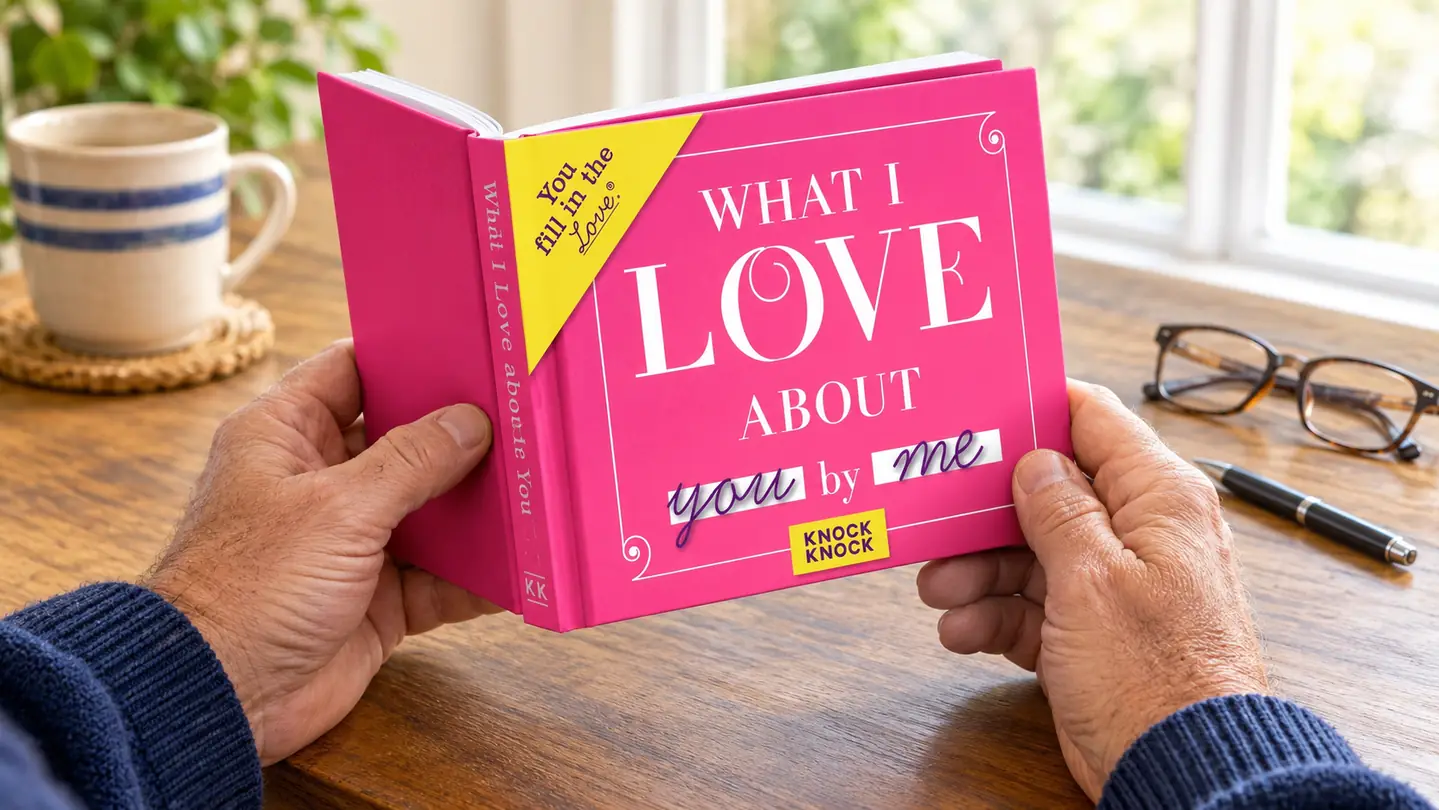
The first time I gave Walt something he actually kept, it was not a watch and it was not a tool. It was a small hardcover book I had filled in by hand, and he stood at the kitchen counter and read the whole thing before he said a single word. Then he put it on the shelf beside his chair, where it still sits. That was the Knock Knock What I Love about You Fill in the Love Book, and I have bought four more since.
I am 63 and retired from a middle-school library. Walt is 66, a retired electrician, and the kind of man who says he does not need anything when you ask him what he wants. We married in June 1986. Buying for a man like that is a puzzle I have been working on for 39 years, and the Knock Knock book solved it in a way a new sweater never has. It is a fill-in-the-blank book: fifty prompts, 112 pages, and the entire gift is whatever you write on the lines. It asks you to do the work. That is the whole point, and it is also the reason some people will hate it.
The Quick Verdict
A tiny hardcover book that turns your own handwriting into the present. Buy it if you will actually sit down and fill it in. Skip it if you want something you can hand over in the checkout line.
Amazon Check Today's Price →The Gift Is the Handwriting, Not the Book
Fifty fill-in-the-blank prompts, 112 pages, 4.5 by 3.25 inches, 3.2 ounces. Small enough to mail, quick enough to read in one sitting, and it gets kept.
Amazon Check Today's Price on Amazon →How I've Used It
I have now filled in five of these. One for Walt, one for my daughter Lauren and her husband, one for my son Ben and his wife, and two for friends who asked me what to get and then decided they wanted one too. The pattern is the same every time. I sit down meaning to spend twenty minutes on it and I spend an hour and a half, because the prompts pull things out of me that I did not know were sitting there.
I filled the first one in at the kitchen table on a Tuesday afternoon in February, with rain on the window and a pot of coffee going cold beside me. I had bought a card the week before and could not make myself write in it. It sat on the counter four days with the envelope unsealed, because a blank card asks an enormous question and I did not have an enormous answer. The book asked something smaller. I had an answer to the first line before I had time to feel foolish, and three hours later I was still there. Walt came through, saw what I was doing, and went back out to the garage without a word, which is his way of giving a person room.
The book is small. 4.5 inches long, 3.25 inches wide, seven tenths of an inch thick, 3.2 ounces. It fits in a shirt pocket. That matters more than it sounds, because a small book feels personal and a large one feels like a project you are assigning someone. Walt carried his out to the porch the first night and read it twice. He has never once reread a card.
The first one I did badly. I answered the prompts the way you answer a form, fast and flat, and the result read like a form. The second one I did slowly and it read like a letter. Same book, same prompts. The difference was entirely how much of myself I put on the line. That is worth knowing before you buy.
What the Fifty Prompts Actually Ask You
The format is a sentence with a gap in it, and you finish the sentence. Some are easy and sweet. Some ask you to name a specific memory, and those are the ones that take time. A few invite you to be a little racy, and the listing says so directly: make it as mushy, racy, or witty as you choose. You set the temperature.
Some of the prompts take ten seconds. Others ask you to name a moment, and moments are harder, because naming one means letting the rest go. One section asks about an ordinary evening, and I sat with that a long while. We have had thousands of ordinary evenings and none of them announce themselves. I wrote about the night the power went out and we ate cold chicken on the porch with a candle between us. It is not a romantic scene. It is ours, and that turned out to be the whole point of the exercise. The prompts I answered fastest were about small habits, the way he fills a kettle or stacks firewood. The ones that took an hour were about feelings, and I suspect that is true for most people who buy this.
What I like is that the prompts do not let you be lazy in the way a blank card lets you be lazy. A blank card asks what you want to say, and on a busy Thursday the honest answer is nothing. A prompt asks a narrower question, and narrow questions are easier to answer truthfully. I have written things in these books that I would never have thought to say out loud.
With 112 pages and fifty fill-in-the-blank sections, it is not a one-evening scribble if you do it properly. Mine took three sittings. I would write a dozen lines, put it down, and come back when something else occurred to me. The book rewards that. There is no timer running.
The Book Itself, Months Later
It is a hardcover with a removable clear plastic jacket, cardboard underneath, plain ruling, and it is bound as a diary rather than a notebook. That last detail is the one I care about. A book bound like a diary lies flat and stays together. I have a fill-in book from another maker that came apart at the spine after a year of being opened and closed, and it lives in a bag in a drawer now.
The clear jacket turns out to matter more than I expected. It keeps the cover from picking up fingerprints and coffee rings, and if it gets scuffed you can take it off and the cardboard underneath is clean. After months on a shelf in a house with a woodstove and a great deal of dust, mine still looks like it did the week I bought it.
The size is the part I did not expect to love. At 4.5 by 3.25 inches it is about the size of a paperback you would carry in a coat pocket, and it stands upright on a shelf without slumping. Walt's sits between an atlas and a tin of screws and has been there for years. The 0.7 inch thickness matters more than it sounds. I have had small gift books vanish into a basket of paperbacks and never come out again. This one has a spine you can read from across the room, which is a small thing until you are the one looking for it.
At 3.2 ounces it is light enough to mail with a card, which I have done twice, and thin enough to slide into a coat pocket, which is how I have carried one without Walt noticing.
How the Handwriting Holds Up
I have gone back and reread the one I gave Walt more times than he has. The ink has not faded. Nothing has smudged, and this is a book that has been handled with sawdust on somebody's hands. The pages are plain, so whatever you write sits there without lines fighting it.
One thing to know: the paper takes a ballpoint well and a gel pen fine, but a fountain pen will ghost through to the other side. I tested it on a back page before committing and I am glad I did. If you write with anything wet, write on one side of the page only, or test a corner first.
Where It Gets Hard
Here is the honest part. This is not a gift until you write in it. Bought and left blank, it is a small blank book, and a small blank book handed over with nothing in it is a slightly awkward present. The value is entirely in the evening you give it.
There is one workaround I would pass on, because it saved the last book I filled in. I keep a sheet of scrap paper beside it and write rough answers there first, badly and out of order, and only copy across the ones that still sound true an hour later. On the most recent one I had eleven rough answers and kept four. The seven I threw away were exactly the lines I would have written on autopilot if the pen had gone straight onto the page, and autopilot is what these books are supposed to cure. It adds maybe twenty minutes over the whole book. It is the difference between something that sounds like you and something that sounds like a card.
I have watched two people buy one and never fill it in. One of them handed it over blank with a pen attached, which is a different gift entirely, and her husband laughed, but not in the way she wanted. If you are someone who shops in the last hour before you need something, this is not your item. There are easier things on the shelf.
The other friction is the prompts themselves. A few will not fit your particular marriage. Walt is not a romantic talker and some of the sweeter lines made me roll my eyes. I answered those in a wry way and moved on. The book does not require you to be sincere on every page, and honestly it is better when you are not.
What I Liked
- Fifty prompts do the hard part of deciding what to say
- Small enough to mail or pocket: 4.5 by 3.25 inches, 3.2 ounces
- Hardcover with a removable clear plastic jacket, bound like a diary to lie flat
- 112 pages, so it reads as a keepsake rather than a card
- You decide how mushy, racy, or witty it gets
Where It Falls Short
- Worth nothing if you do not fill it in
- A handful of prompts will not fit every relationship
- Takes an hour or more of real writing
- Wet ink ghosts through the page
- Handwriting cannot be deleted the way a typed note can
A blank card asks what you want to say. A prompt asks a narrower question, and narrow questions are easier to answer honestly.
How It Compares to a Blank Journal
A blank journal is the obvious alternative and I have given both. The difference is decision fatigue. Hand someone an empty page and a lot of people freeze. Hand them a sentence with a gap in it and they write. If the person you are buying for keeps a journal already, by all means get the journal. If they do not, the prompts are the entire value.
The second difference is length. A blank journal invites you to fill pages, and most people fill two and stop. This one is 112 small pages and fifty prompts, which is a bounded task. You can finish it. A finished thing is a gift. An abandoned thing is clutter, and I have given my share of clutter.
What I'd Change
I would print on slightly heavier stock so a fountain pen behaved. I would add a ribbon marker, because I lost my place twice and ended up writing on the wrong page. Those are small complaints and neither stopped me from buying another one.
The bigger regret is on me, not the book. I wish I had bought two the first time. I filled one in for Walt, he liked it, and then I had to wait for a second copy to arrive before I could do the same for Lauren and her husband. Now I keep a spare on the shelf the way I keep a spare jar of jam.
Who This Is For
Buy it if you are giving to a spouse or partner and you are willing to spend an evening on it. Buy it if you are the person your family calls for gift advice, because the Knock Knock book is the one I hand over when somebody says their father is impossible to buy for. Buy it for a first anniversary, a tenth, or a Tuesday. The occasion is not the point. The handwriting is.
It also works as a small add-on. Put it beside a bigger present and it will be the thing they mention afterward. I have seen that happen three times now, including with my own son, who is not an easy audience.
Who Should Skip It
Skip it if you will not write in it. Skip it if the relationship is new enough that you cannot fill in fifty prompts honestly, because you will write filler and filler reads like filler. Skip it if the person you are buying for does not keep things. I love Ben, and Ben has never kept a card in his life. I gave him one anyway and I know exactly where it is, in the box with his high school trophies. That is a fair outcome for him and a wasted evening for me.
And skip it if you want a gift that arrives finished. This one arrives about forty percent finished and you are the other sixty. That is the deal, and it is a good deal if you go in knowing it.
Fifty Prompts, One Evening, and a Book He Will Actually Keep
The Knock Knock What I Love about You book is 4.5 by 3.25 inches, 112 pages, hardcover, and it only works if you write in it. That is the whole offer, and it is enough.
Amazon Check Today's Price on Amazon →