
Walt and I were married in June 1986, which means I have bought thirty-nine anniversary gifts, and I can tell you exactly which ones he still uses. A pocket knife. A pair of work gloves. A coffee mug that has survived four dishwashers. Everything else lives in the drawer in the hall, and you have that drawer too.
The trouble is not that people pick bad gifts. It is that they pick gifts for the occasion instead of for the person. A necklace from a mall kiosk in a velvet box. A candle that smells like a hotel lobby. A reservation at a restaurant you would have gone to on a Tuesday anyway. None of those say anything specific. What lands is something with a little thought built into the object itself, and the version of that I keep coming back to is a preserved rose with a necklace tucked in with it. My daughter Lauren has one from moshen sitting on her dresser, and Lauren is forty-one and not easy to impress. She has opinions. She told me all of them.
The One That Arrives Ready to Hand Over
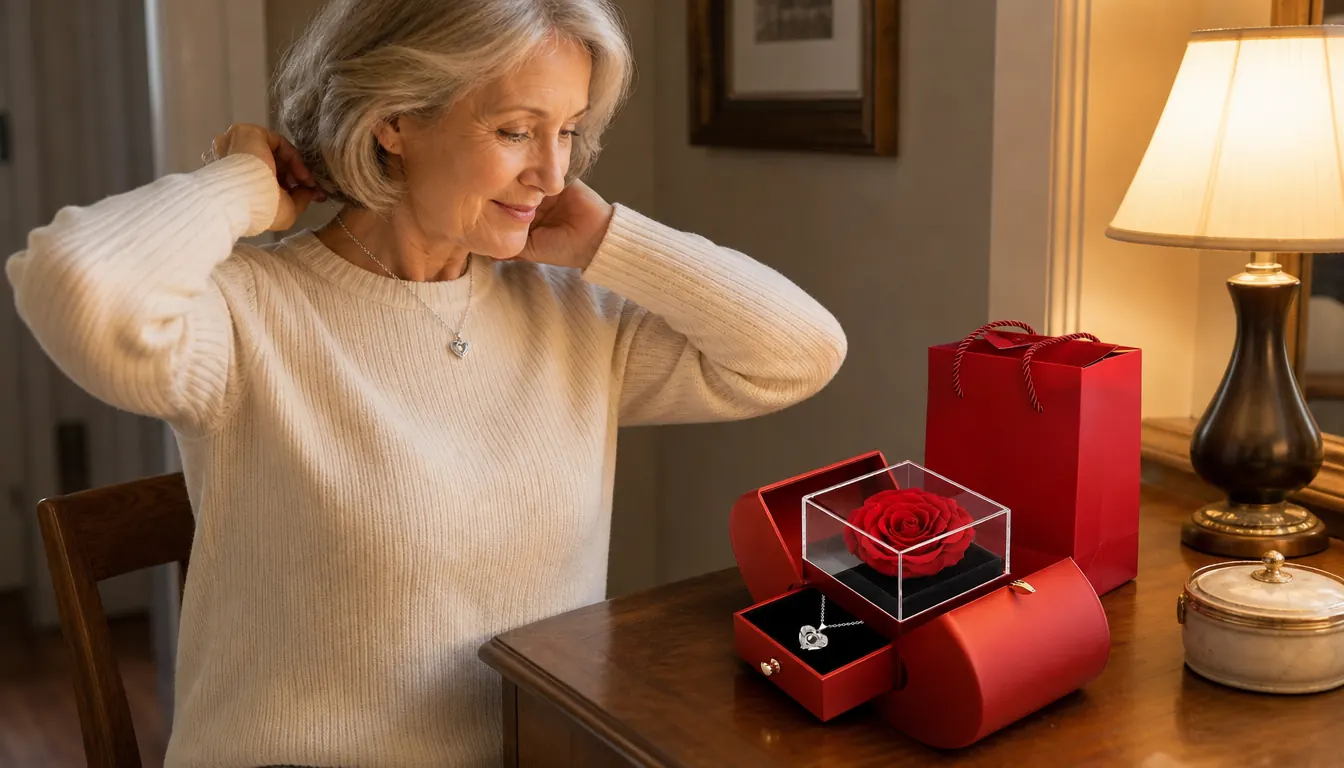
The moshen set includes the preserved rose, the necklace, a jewelry box, a gift bag and a message card. No wrapping paper, no Tuesday night trip to the mall.
Amazon Check Today's Price on Amazon →Step 1: Decide What the Gift Is Supposed to Say Before You Shop
Most people shop backwards. They find an object they like, then try to attach a meaning to it, and the result always feels a bit off, like a card signed by somebody who did not read it. Do it the other way around. Before you open a single tab, answer one question in plain words: what do I want her to understand when she lifts the lid? Write it on the back of an envelope if you have to. Everything in the next four steps is just checking whether the thing you are about to buy says that.
For an anniversary, the answer is usually some version of I would pick you again. That is a staying message. Staying messages are hard to buy, because most gifts are consumption. Flowers are dead in a week. Chocolate is gone by Tuesday and the box goes out with the recycling. A preserved rose under a clear acrylic cover is a staying object. It sits on a shelf and asks nothing of anybody. That is not a small thing when you are sixty-three and the house is already full of things you both like well enough.
The moshen set is the one I know best, because Lauren brought hers over and made me look at the projection stone in the kitchen light. What I noticed is that it is built to be given rather than used up. The rose is real and preserved. The necklace sits with it. The whole thing is one object with one message, not a basket of small items that each say something different. Walt does not need another basket of small items. He needs to know I noticed him this year, which is a different shopping problem entirely.
Step 2: Learn What Preserved Actually Means
Preserved is not a polite word for plastic. It means a real flower that has been treated so it holds its shape and never needs water. The moshen box uses a preserved real rose under a clear acrylic cover, so what you are looking at is a flower in a small glass case rather than a plant on a windowsill. If you are expecting a living thing that will open and change day by day, you will be disappointed, and I would rather tell you that now than have you find out on the morning of.
What preserved buys you is the absence of chores. No vase to fill. No water to change. No petals on the tablecloth the morning after. You set it down and it stays put, which is exactly what you want from something that is going to live on a dresser next to a lamp and a jar of buttons. The tradeoff is that it will not change. Some people find a flower that never opens slightly sad. I find it restful. I have killed enough hydrangeas to know which side of that question I am on.
The honest limit: it is still a flower. Over years it will fade, and direct sun will hurry that along. The one on Lauren's dresser sits away from the window and looks much the same as it did the week she got it. If you need something that will be identical in twenty years, buy a piece of jewelry and skip the flower entirely. If you want something that looks like a rose this June and still looks like one next June, this is the right shape of gift.
Step 3: Read the Necklace Specs Against What She Already Wears
This is the step people skip, and it is the step that decides whether the necklace gets worn or stored. The moshen pendant is a 45cm adjustable chain with a projection stone engraved with I love you in 100 languages. Forty-five centimetres is the collarbone zone. It sits above a crew neck and inside a V neck, which is where most women over sixty actually want a pendant, because it does not tangle in a collar and does not disappear under a sweater.
Adjustable matters more than it sounds. A fixed 45cm chain on a small-boned woman hangs lower than the maker intended, and a pendant that lands in the wrong place is a pendant that gets put away. The chain is a cable type, the plain interlocking link most people picture when they hear the word chain, and the clasp is a buckle rather than a spring ring. A buckle takes two hands and a bit of patience. If her hands are stiff in the morning, plan to fasten it for her the first time. That is not a defect in the gift. It is a small piece of the gift.
The metal is nickel silver with a polished finish, and the setting is inlay with a round brilliant stone shape. Nickel silver is not silver, and the listing says so plainly with a no stamp notation, which I appreciate. If she reacts to nickel, this is not the piece for her, and you should say that out loud before you buy rather than after. Being told the truth about a clasp is worth more than a surprise. Especially at our age, when we have all bought a few things that turned our wrists green.
Forty-five centimetres puts the pendant at the collarbone, which is where a necklace gets worn instead of stored. That one measurement decides more than the engraving does.

Step 4: Treat the Packaging as Part of the Gift
A gift handed over in a plastic sleeve is a purchase. A gift handed over in a box is a gift. The moshen set arrives with a rose jewelry box, a gift bag and a message card, so there is no Tuesday night run for wrapping paper and no scissors-and-tape job at ten o'clock on the night before. I have done the scissors-and-tape job. It shows. The corners are wrong, the tape is visible, and everybody can tell.
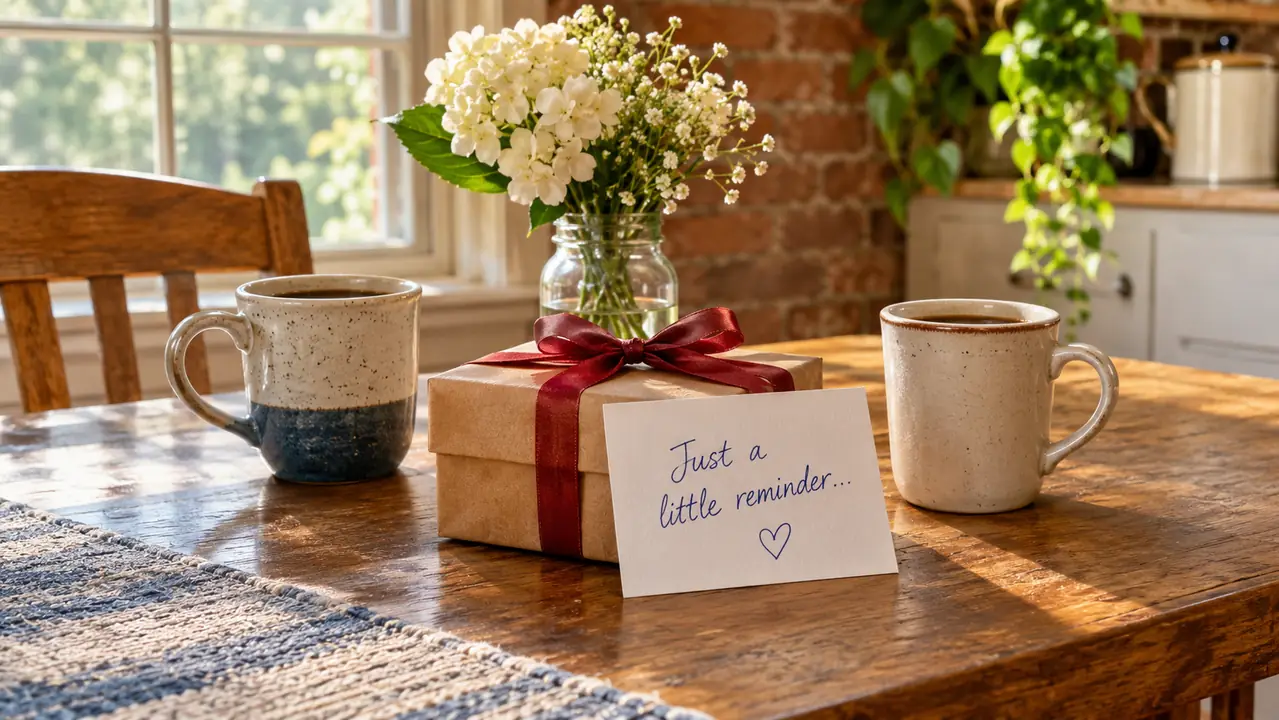
The message card is the part I would slow down on. It comes to you blank, which means the words are yours, and three lines in your own handwriting beat a printed verse every single time. Write down one specific thing from the past year. Not I love you. You will say that anyway, probably at the door. Write something like: you fixed the gutter in the rain in March and I never thanked you properly. That is a sentence only you could have written, which is the whole point of a card.
One practical caution about presentation. Do not leave the box in the trunk of a car all afternoon in July and then carry it in at seven. Preserved or not, a flower that has been sitting in a hot car is a bad start to an evening. Bring it inside when you get home, set it on the kitchen table, and give it before dinner rather than after. The difference between before and after is the difference between a gift and a receipt.
Step 5: Plan the Handoff, Not Just the Purchase
The last decision is when and how, and this is where most people default instead of choosing. They wait for the restaurant. The box comes out between the entree and the dessert, the waiter is hovering with a candle, and the moment belongs to the room instead of to the two of you. I have watched this happen at the next table. It is a lovely scene for everyone except the couple in the middle of it.
Give it at home, in the morning if you can manage it. Coffee, kitchen table, no audience. Hand it over and then stop talking, because the urge to narrate the purchase is strong and narrating ruins it. Let her open the lid. If she is the sort to say you should not have, and most of us over sixty are, do not argue and do not explain what it cost. Say I wanted to, and let it sit there. The silence after that is usually the best part of the morning.
Then put it somewhere. This is what decides whether a gift becomes furniture or a drawer item. Clear a spot on the dresser, or the shelf by the window, before the day arrives, so the rose has a home the moment it comes out of the box. A gift with a spot is a gift that stays. A gift that is waiting for a spot goes into the hall drawer with the coasters and the dead batteries, and eighteen months later neither of you can remember who gave it.
What Else Helps
If the necklace is a risky call because of the nickel, let the rose carry the gift on its own. Give the moshen box as it comes, and put the other piece, a pair of earrings, a ring from her mother, in its own small box beside it on the table. Two boxes read as more thought than one box with everything crammed together, and you avoid guessing her ring size at the last minute, which is a guess you will lose.
Two more things. Check the calendar before you buy, not after. A gift that arrives the wrong week is a reminder that you forgot, which is worse than a gift that arrives a day late. And if you are buying for a parent's anniversary rather than your own, which is what Lauren and Ben do with me every June, ask one question first: does she wear necklaces at all? Half the women I know stopped wearing them when the clasps got too fiddly and never went back. If the answer is no, buy the rose and a pair of earrings. Half a gift that fits beats a full set that does not.
The Version That Shows Up Ready to Give
The moshen set arrives with the preserved rose, the necklace, a jewelry box, a gift bag and a message card. You supply three lines in your own handwriting and a spot on the dresser.
Amazon Check Today's Price on Amazon →