

Every spring my husband Walt starts asking what I want for our anniversary, and every spring I tell him the same thing: nothing that needs dusting. Then he says he does not need anything either, which is what he has said since June 1986, the month we were married. So I buy the gift anyway. Thirty-nine years in, I have gotten particular about which gifts survive past the card, and which ones go into the drawer by the hall closet and stay there.
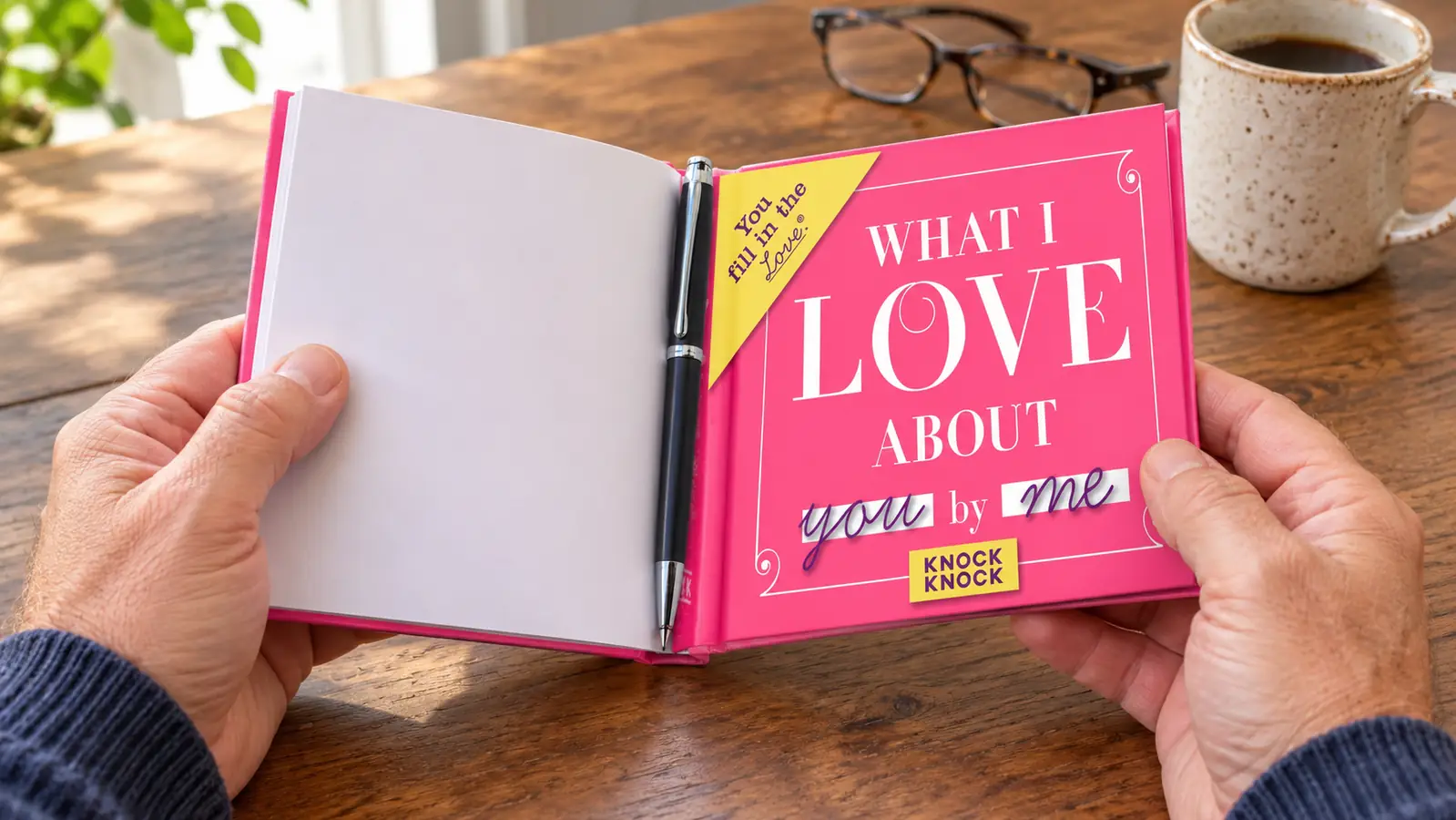
Here is the short answer, since that is why you clicked. The Knock Knock What I Love about You Fill in the Love Book beats a blank journal for almost everyone. The Knock Knock book hands you fifty prompts across 112 pages, one short line at a time, in a hardcover that measures 4.5 by 3.25 inches and weighs 3.2 ounces. A blank journal only wins when the person doing the writing genuinely wants to write at length, and most of us do not, no matter how much we love the person we are writing to.
I spent thirty years as a middle-school librarian in Asheville, so I have watched a great many people freeze in front of an empty page. I have also filled in one of these little books for Walt, and I bought a plain lined journal to try the other way, and I have an opinion about which one gets finished.
| Knock Knock Fill in the Love Book | A Blank Journal | |
|---|---|---|
| Structure | Fifty fill-in-the-blank prompts printed across 112 plain pages, ready to complete | Empty pages you fill from scratch |
| Starting point | The prompt supplies the first half of the sentence | You supply the whole thing |
| Room for a long letter | Short lines, one thought per prompt, in a book 4.5 by 3.25 inches | As much space as you want, page after page |
| Second chances | Ink goes down permanently on a printed line | Draft it, cross it out, or start the page over |
| Portability | 3.2 ounces, 0.7 inch thick, fits a coat pocket or a purse | Usually larger and heavier |
| Finish line | An evening or two of short sittings gets it done | Open-ended, and easy to leave half empty |
| Look on a shelf | Cardboard hardcover with a removable clear plastic jacket | Depends entirely on which one you buy |
| Best for | A gift you want to hand over finished | A writer who has something long to say |
What You Actually Get
The Knock Knock book is 112 pages bound in a cardboard hardcover with a removable clear plastic jacket. It measures 4.5 inches long, 3.25 inches wide, and 0.7 inch thick. The paper is plain rather than ruled, which matters more than it sounds, because the lines are printed with words already on them and whatever space is left is for handwriting. You are not fighting a rule that runs the wrong direction or a margin that eats the last word.
The prompts are short. Fifty of them, one per section, each one starting a sentence about the person you are giving it to. The listing says to make it as mushy, racy, or witty as you choose, and that is accurate. You can be sincere on one page and ridiculous on the next and the book holds together either way. There is no wrong order and no place you have to start.
The physical object is small enough to be a problem, in the good sense. It disappears into a coat pocket. It sits in a purse without taking up the room a paperback would. Walt is not a man who carries things, and even he put it in the truck's glove box for a week so he could add a line while he was waiting on a part. He got four lines done that week, all of them in parking lots, and every one of them was better than anything he would have written sitting down at a desk with a fresh page in front of him.
Now the blank journal, which is exactly what it sounds like: pages, a cover, and no help at all. Good paper, probably a ribbon marker, and no idea what belongs on page one. That is not a knock against it. It is an honest description of the job it hands you.
Where the Knock Knock Book Wins
The first thing it wins on is the start. The hardest part of writing anything is the first sentence, and a prompt removes it. When the page reads I love the way you and then stops, your brain has something to push against. You are not inventing a whole paragraph out of affection and thin air. You are filling in a blank the way you would fill in a form at the doctor's office, except the form is about your marriage.
The second thing it wins on is finishing. A gift that is half done is worse than no gift, because now there is a small unfinished obligation sitting on the end table. A blank journal invites the someday treatment. It is a project. Fifty short lines is a job you can finish in two sittings at the kitchen table with the radio on, and there is a real difference between a gift that is ready on the day and a gift that is a promise about a future evening that never arrives.
The third thing is that it gets read more than once. A finished Knock Knock book sits on a nightstand and gets opened on a bad Tuesday. A journal filled with a long letter gets read once, carefully, and then shelved, because rereading four pages takes a commitment. Two lines on a small page is a thing you can take in while the kettle boils.
Where a Blank Journal Wins
If the person doing the writing is the sort who writes three pages when a card would do, the little book will frustrate them. There is no room for a story. There is no room to explain the year the furnace died and what it meant that Walt fixed it himself at eleven at night. A blank journal gives you as much space as you want, and for that particular kind of letter, the space is not a small thing. It is the whole point.
The other place the journal wins is the mess. Ink on a printed line is permanent. If you write the wrong thing, or the right thing badly, there it stays in a book you are handing to someone you love. In a journal you can draft, cross out, tear the page out, start again. For a perfectionist, or for anyone who writes their way into a thought, that room to be wrong is worth more than fifty prompts.
Fifty prompts, two evenings, a gift that is actually finished
The Knock Knock What I Love about You Fill in the Love Book is 4.5 by 3.25 inches, 112 pages, hardcover with a removable clear plastic jacket. Small enough to fill in at the kitchen table without clearing your whole afternoon.
Amazon Check Today's Price on Amazon →
The Blank Page Problem, in Plain Terms
I have heard the same sentence from a hundred people over the years. I would rather write something myself. They mean it. They are not being lazy. Then they sit down with a nice journal and a nice pen, they write Dear Walt, and they stop. Twenty minutes later they are still looking at Dear Walt. The pen has dried on the nib. They put it away and tell themselves they will come back to it on Sunday.
This is not a character flaw. It is how writing works. A person with nothing to push against produces nothing. Every decent piece of writing I ever helped a twelve-year-old with started the same way, with a question narrow enough to answer. What did the kitchen smell like that morning. Who said the thing you still remember. The Knock Knock book is that idea applied to a marriage, fifty times over, and it works for the same reason it worked on seventh graders.
I tried the blank journal first, and I want to be straight with you about how that went. I bought a nice one with a linen cover in the fall, and I filled two pages and then set it on the shelf above the desk. Two pages. Then I moved it to the drawer, then to the box in the closet where the wrapping paper lives, and eventually I found it again in a spring cleaning and read what I had written. It was not bad. It was just short, and there were months of blank pages after it that made the whole thing feel like a letter I had abandoned, which is exactly what it was.
What I'd Tell My Daughter
My daughter Lauren called me in March about her own anniversary and asked whether a fill-in book was too small a gift, since her husband is the sort who notices when a present cost some thought. I told her the opposite is true. A small book that took two evenings of actual remembering lands harder than a larger object chosen in eleven minutes. The size of the box is not the measure. Whether the words are specific is the measure.
She also asked the question you are probably asking, which is whether it feels like homework. It does, a little, for the first three prompts. Then it stops feeling like homework, because the prompts get specific enough that you start remembering things you had not thought about in years. Walt's version of that was the line about how I take my coffee, which he has teased me about since we were dating and which I did not know he had noticed was a habit rather than a preference.
So my advice to her was the same advice I will give you. If you want to hand someone a finished thing on the day, buy the Knock Knock book. If you want to hand them a blank journal, be honest with yourself about whether you are going to fill it.
Fifty short prompts beat a hundred empty pages, because the empty pages ask you to be a writer and the prompts only ask you to be honest.
Who Should Buy Which
Buy the Knock Knock book if you are not a writer, if the anniversary is close enough that you cannot spend three weekends on it, if you want something that fits in a purse or a coat pocket, or if the person receiving it is the sort who will open it more than once. Buy it if you have tried the blank journal before and there is still a half-empty one in the desk drawer. That drawer is the most honest review you will ever get.
Buy a blank journal instead if the writer in the pair is the person who actually writes, meaning long letters, real pages, drafts they revise. Buy it if the story you need to tell does not fit on a short line, or if the gift is meant to be a shared project the two of you fill in over a year. Buy it for a milestone anniversary where the letter is supposed to be the whole gift and not a note tucked beside something else.
There is a middle path, and I have used it. Give the Knock Knock book as the gift and keep the blank journal for yourself, for the longer things you want to say that do not fit in a prompt. The small book is what gets handed over. The journal is where you work out what you actually mean before you write it down in ink. I keep mine in the drawer now, and it has earned its place there, because it is a workbench and not a present.
One last thing, and then I will let you get on with it. Whatever you choose, fill it in before the morning of. A finished book on the table with the coffee is a different gift than a book handed over with an apology and a promise. The whole advantage of fifty prompts is that you can finish it in an evening. Use the evening.
The version that gets finished before the date on the calendar
The Knock Knock Fill in the Love Book: 112 pages, fifty prompts, a cardboard hardcover with a removable clear plastic jacket, 3.2 ounces. Fill in a few lines a night and hand it over done.
Amazon Check Today's Price on Amazon →