

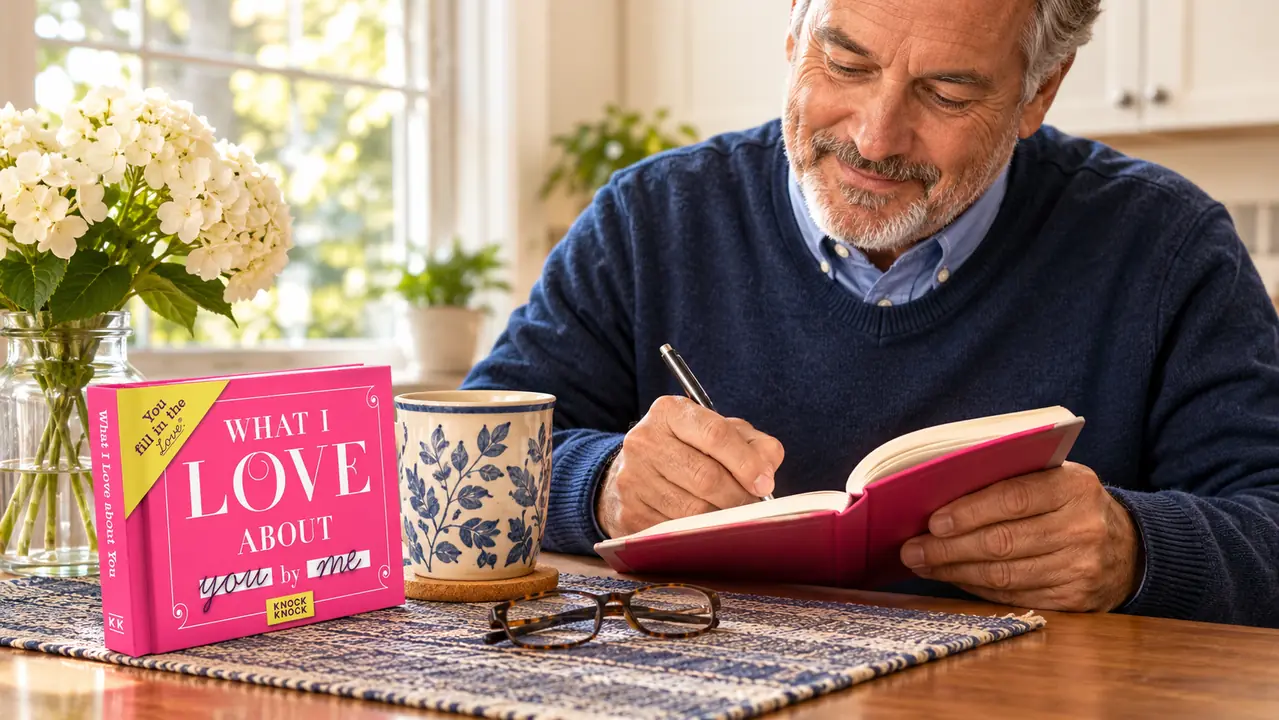
Walt is hard to shop for. We have been married since June 1986, which makes thirty-nine years this summer, and the man still says he does not need anything. He means it, too. He does not need another belt, another pair of work gloves, or another gadget that ends up in the garage drawer next to the gadget from two years ago. What he needs is harder to wrap. So a few years back I stopped shopping for him and started writing to him instead, using a small hardcover book from Knock Knock called What I Love about You.
Here is the anniversary problem in plain terms. You want to mark the day. You do not want to buy something that gets a polite nod and then lives in a drawer until you move house. Dinner at the same restaurant is fine and forgettable. Jewelry is a great deal of money for a man who works with his hands. Flowers die by Thursday. A fill-in-the-blank book asks for two or three evenings of attention instead of a shopping trip, and it is the only gift I have given Walt that he has gone back to more than once, unprompted, months later. That is the whole argument for it. Below is how to choose it, how to fill it out so it does not read like a greeting card, and where it falls short.
Two evenings of writing beats a shopping trip nobody remembers
The Knock Knock What I Love about You book is 112 pages of fill-in lines, 4.5 by 3.25 inches, hardcover with a removable clear plastic jacket. You supply the specifics. They keep the book.
Amazon Check Today's Price on Amazon →Step 1: Decide whether a written gift fits your spouse
Step one has nothing to do with the book. It is about whether a written gift fits the two of you. Some marriages run on words and some run on deeds, and both are honest ways to run a marriage. If your spouse would genuinely rather have a new set of socket organizers than a paragraph about his hands, believe him and buy the socket organizers. The book is not a test of how much you love somebody, and it will not fix a cold year.
The tell is what they keep. Walt and I are not sentimental out loud. We say drive safe instead of the other thing, and we have said it for four decades. But there is a drawer in the kitchen with every card I have ever given him in it, going back to the eighties, and he can tell you which year each one came from. That drawer is the tell. Look for yours. If your person keeps the notes and the ticket stubs and the programs, this gift lands. If your person throws the card away with the wrapping paper and feels nothing about it, save your evening.
It also helps to know exactly what the object is, so nobody is surprised on the day. The Knock Knock book is small. It measures 4.5 by 3.25 inches and runs 112 pages, with a hardcover and a cardboard cover under a removable clear plastic jacket, and it weighs 3.2 ounces. Inside are about fifty fill-in-the-blank lines, each one starting a sentence about your person that you finish by hand. There is nothing to charge, nothing to download, nothing to assemble, and no refills to buy later. It fits in a coat pocket, which matters more than it sounds like it should. A gift that lives on a nightstand gets read. A gift that lives in a closet does not.
Step 2: Set your scope before you write a single line
The book will take as long as you let it. My advice is three short sittings across a week, ten or twelve lines each, with the book somewhere visible so you keep thinking about it between sittings. The versions of this that go badly are the ones started on the afternoon of the anniversary with a pen borrowed from the car. You can hear the hurry in the handwriting, and so can they.
Decide up front how many lines you are filling. Fifty is the goal and fifty is doable over three evenings, but if you stall at line thirty and hand over a half-finished book, that reads as a half-finished thought. Either commit to the whole thing and spread it out, or choose the twenty prompts that suit your marriage and skip the rest on purpose. Nobody counts. There is no completion certificate, and a book with twenty good lines beats a book with fifty lines that all say the same thing in different words.
Second scoping decision, and this one matters more than people expect: what register you are writing in. The prompts run from tender to a little racy, and the cover copy says plainly to make it as mushy or as witty as you choose. Walt would have been mortified by a book of pure endearments. He can take tender, but he needs a joke on the same page to carry the weight of it. You know which one your spouse is. Write for that person and not for the version of them you wish you had married.
Step 3: Collect the evidence before you write
The reason most people freeze at the first line is that they are trying to be poetic. Do not be poetic. Be accurate. Poetic is what makes these books read like a card from the pharmacy. Accurate is what makes them get read twice. Give yourself a week, keep a note on your phone, and put things in it as they happen instead of trying to remember them all at once on a Friday night.
What goes in the note: objects, habits, dates, and small mercies. Walt labels every breaker in the electrical panel in pencil, and the labels from 1994 are still in his handwriting. He makes the coffee before he makes any noise, so I get ten quiet minutes. He has spent more Saturday mornings than I can count up a ladder working through my list instead of his. Those are lines. Not you are my rock. That line is true and it is also the line everybody writes.
Gather a few things you can hold, too. A photograph from the year you met. A receipt from a trip you still talk about. The name of the song that was playing in the truck the night you decided. Objects pull memory, and memory is what you are actually writing down. If you have grown children, ask them what they remember about the two of you from when they were small. Lauren and Ben have reminded me of things I had completely forgotten, and more than one of those reminders went straight into a book.
Keep the note for the whole week even after you start writing. The best line usually arrives on day five, in the car, when you are not trying. Write it down before you lose it, because you will lose it.

Step 4: Fill the lines the way you talk
Write the way you talk, and write short. If you would not say it across the kitchen table, do not put it in the book. This is the part that scares people who claim they are not writers, and it is exactly why the format works. The prompt has already started the sentence. You are only landing it. Half the work is done before you pick up the pen.
Practical matters, because the pages are small and the lines are short. Use a pen that will not smudge, and write slowly enough that the words stay legible in twenty years. If your handwriting has gone shaky, that is fine and in my opinion it improves the gift. Leave a line blank if you truly cannot answer it rather than filling it with filler. Do not be precious about keeping the book perfect. It is 4.5 by 3.25 inches and it is supposed to look handled.
Mix the registers on purpose. Put a tender line, then a funny one, then something specific enough that only the two of you would understand it. A page that says I love how kind you are is a nice sentence that could belong to anyone. A page that says I love that you hum along to the truck radio, badly, and stop the second you catch me listening belongs to one man in Asheville. The second page is the one that gets read on a bad Tuesday in February.
Read the whole thing back in one sitting before you hand it over. This is the step people skip and it is the one that catches problems. You will find repeated words, two lines that say the same thing, and at least one line where you tried to be funny and came off mean. Fix that one. Check the spelling of your children's names, because I have gotten that wrong in a card and I have never heard the end of it.
Fifty short lines, ten minutes a night, one specific person. That is a whole anniversary gift, and it fits in a coat pocket.
Step 5: Finish it properly and hand it over
Sign it and date it on the inside cover, in pen, the way you would sign a letter. A book like this without a date is a book without a year, and the year is half the value ten years from now. If you have children, add one line meant for them, because they will read it eventually, probably long after you have handed it over, and it will matter to them more than it matters to you.
Leave the clear plastic jacket on. It looks like packaging and it is not. It is the thing that keeps the cover from going soft after a decade on a nightstand. Let it look a little worn in a few years. Worn is what you want.
Hand it over at the table after the plates are cleared, not as the first thing in the morning when everyone is still finding their shoes. Give it on its own, not taped to something bigger, because a gift that needs a bigger gift beside it is a gift you are apologizing for. Then leave the room for ten minutes and let them read it without an audience. Walt reads anything like this the way he reads the manual for a new truck: slowly, in order, and then again from the beginning.
What Else Helps
Pair it with something small and edible. A bar of good chocolate, a card, a decent pen they can keep afterward. Do not bury it in a hamper. The whole strength of this gift is that it is the entire thought, and a pile of extras next to it argues with that.
If you are short on time, fill twenty lines well and write on the first page that the rest is coming, then actually finish it over the following month. A promise on page one that gets kept is a better gift than fifty rushed lines, and it gives the two of you something to come back to in the spring.
Keep a cheap spiral notebook for the drafts and write the lines there first. It takes the fear out of the good book, and it means you are not crossing things out on pages you paid for. When a line sounds right out loud in the kitchen, copy it over.
Be honest with yourself about what it will not do. It will not replace saying any of this out loud, and it will not repair a year in which the two of you have not been kind to each other. No object does that. What it does is put fifty chances to be specific about one person in a place they can go back to whenever they need it. That is a modest thing and it is not a small one, and for the cost of a few evenings it is the best return I know of.
You already know fifty things about them. Write them down.
The Knock Knock What I Love about You book: 112 pages, about fifty fill-in lines, hardcover with a removable clear plastic jacket, 4.5 by 3.25 inches. Give it with a pen and an hour of quiet.
Amazon Check Today's Price on Amazon →