

The first thing worth knowing about this book is that it is smaller than almost everyone pictures. Four and a half inches tall. Three and a quarter inches wide. Seven tenths of an inch thick, 3.2 ounces on my kitchen scale. If you are imagining a journal you would leave out on a coffee table, imagine a greeting card that decided to become a book instead. That size is either the whole point or the whole problem, and which one it turns out to be depends entirely on what you plan to hand somebody.
I have filled out three of these Knock Knock books now. One for my husband Walt, who is 66, hard to shop for, and firmly of the opinion that he does not need anything. One for my daughter Lauren and her husband when they asked me to help them get it right. And one I talked a friend through over the phone while she panicked about the very first page. So I have opinions, and a few of them are not flattering to the book.
The Quick Verdict
A small hardcover with fifty fill-in prompts and 112 pages. Excellent for someone willing to actually sit down and write. A shelf ornament for anyone who is not.
Amazon Check Today's Price →Fifty Prompts Already Started, So You Are Not Staring At A Blank Page
A 4.5 by 3.25 inch hardcover with 112 pages, a removable clear plastic jacket, and fifty half-finished sentences. You supply the handwriting.
Amazon Check Today's Price on Amazon →What Is Actually in the Book
Fifty fill-in-the-blank prompts. One hundred twelve pages. A hardcover with a cardboard cover, a removable clear plastic jacket, plain ruled lines, and a diary binding. That is the entire inventory, and it is worth being clear about it before anybody decides anything. There are no photo pockets and no envelope in the back. What there is, is fifty half-finished sentences waiting for you to complete them in your own handwriting. If you want a book that does the emotional work on your behalf, this is not that book.
This is the part I like, and it is the reason the format has lasted. The prompts give you a running start. Each one opens a thought and then stops: what you love about the way they do one particular ordinary thing, what you noticed the first time you saw them do it, what you would say if you had a single line and no room to warm up. You are not staring down an empty page trying to summon a speech. You are finishing a sentence somebody else began. For anyone who has ever frozen in a card aisle, that difference is not small.
Physically it behaves like a small hardback, not a notebook. It fits in a coat pocket. It fits in a padded envelope with room to spare. It sits on a nightstand without taking up the space a water glass would. The plastic jacket is genuinely removable if the shiny look bothers you, and the cover underneath is plainer for it. Four and a half by three and a quarter inches, seven tenths of an inch thick, which is thinner than the paperback you would take on a plane.
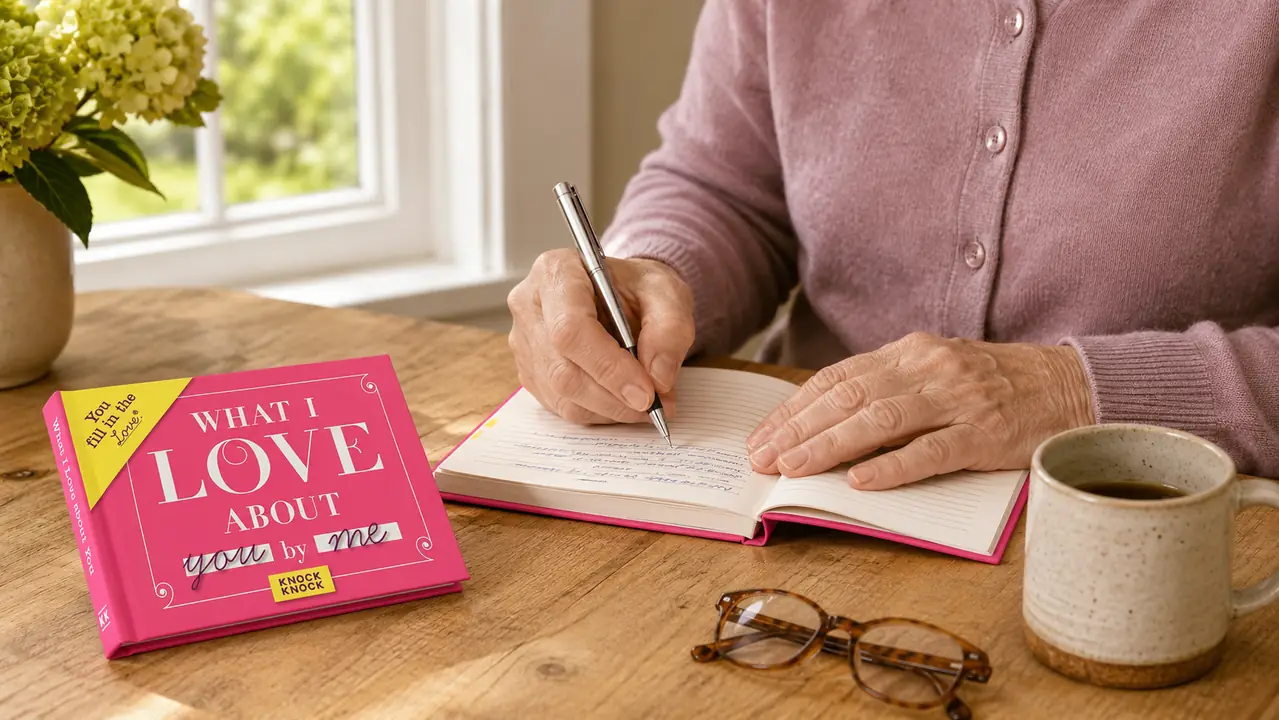
The ruling is plain, which surprised me the first time. No dots, no faint lines to govern the height of your letters, just clean blank space under each printed prompt. My handwriting wanders uphill without a baseline, and the first copy I filled in shows it plainly on every page. For the second copy I laid a pencil line with a small ruler and erased it afterward, which sounds fussy and cost about ten extra minutes across the whole book. If your handwriting is tidy, none of this matters to you. If it is not, know what you are getting into before you start.
What Nobody Tells You Before You Fill In the First Line
Here is the part the listing does not lead with. All fifty prompts are printed and fixed, and you do not get to invent your own. Some of them will land perfectly for your person. Two or three will make you sit back and think, well, that is not really us, and there is no way to skip forward that fixes it. You can leave a line blank. You can answer it sideways. What you cannot do is reorder the book without turning it into a craft project.
The lines are short. This is a 4.5 by 3.25 inch book, so there is room for a sentence, maybe two if you write small and skip the flourishes. If you are the sort of person who wants to write a paragraph, you will run out of paper before you run out of things to say, and your handwriting will get cramped and tiny somewhere around page eighty. My most recent copy has noticeably smaller writing in the back half. The last few pages look like they were filled in by a much older woman.
I tested this on the third copy. I wrote the answers out on a legal pad first, planning to copy them over neatly. It took twice as long and the copied version read like a school assignment, all careful and none of it mine. The lines I wrote directly into the book, crooked ones left crooked, were the ones that sounded like me. Now I write straight into the book and I do not draft. The only thing I plan ahead is which prompt gets the sentence I care most about, and I decide that in the first minute, then stop thinking about it.
And the thing nobody says out loud: the book does not write itself. It arrives blank and it stays blank until you sit down with a pen and stay there. I have watched two people buy it as a last-minute save and then leave it on the counter until the morning of the anniversary. One of them handed it over half finished. It was still well received, but it was not the gift she meant to give, and she knew it when she passed it across the table.
Tone is the other thing. The prompts invite you to be as mushy, as racy, or as dry as you actually are, and the book does not push you toward any of them. That is a feature. It is also a trap for anyone who reaches for a joke when they get uncomfortable, because a book of fifty jokes reads very differently from a book of fifty sentences. Decide which one you are writing before page one, because you cannot quietly change course on page forty.
Fifty prompts, 112 pages, and about ninety minutes of real work. The ninety minutes are the gift. The book is the wrapping.
The Part That Surprised Me
What I did not expect was how much the filling-in changed what I noticed. Somewhere around prompt twenty you stop writing about your person in general and start writing about specific Tuesdays. The way Walt lines his work boots up against the wall by the back door. The fact that he has mowed around the vegetable garden for thirty-nine summers without once suggesting we shrink it. General affection is easy to put on a card. Specifics are what make somebody set the book down in the middle and look at you.
The second surprise was the rereading. A card gets read once and propped on a shelf somewhere. This is a bound book, so it lives on a bedside table and gets picked up again. Walt has been through his at least four times that I know about, and once out loud in the kitchen, which he will deny if you ask him directly. A friend tells me her husband keeps his in the truck. I would not have predicted that from something weighing 3.2 ounces.
A third surprise, and this one is less flattering. I got better at it as I went, and the book kept the evidence. Pages ten through twenty are noticeably weaker than pages seventy through ninety, and a stranger reading front to back would watch me learn to say things plainly over the course of an afternoon. I have made my peace with that. It is a record of a person trying, and trying has a shape, and the shape is never a straight line.
How I Would Fill One In Now
Fill it in over a week, not over an evening. The prompts work better when you are not performing. I keep a pen on the kitchen counter and add two or three lines while the kettle boils, and the lines I write that way are almost always the ones Walt mentions afterward. The ones I wrote in a single sitting on the last night are technically complete and completely forgettable.
Write the specific thing and skip the adjective. You are patient is a line anyone could write about anyone. You waited two hours in the parking lot the day the alternator went and never once made it my fault is a line only one person on earth could write. The book gives you fifty chances to do the second kind. Use them.
Do not save your best answer for the end. You will be tired by page ninety and your handwriting will show it. Put your strongest line around prompt ten, where it gets read first and read again, and put the steady, ordinary ones in the middle where they can do the quiet work. The middle of a book like this is not a demotion. It is where the rereading happens.
Use a fine pen. A fat marker will not fit these lines and will leave you writing four words per page, which is not much of a gift. A pencil smudges on something that gets carried around the house. Whatever you choose, try it on an inside page first, because there is no clean second attempt once the ink is down and no way to rip a page out without it showing.
One more thing about the order. I read the whole book through once before writing anything, marking the eight or ten prompts I already had an answer for. Filling those first built momentum, and by the time I reached the harder ones I had been writing for twenty minutes and the words came easier than they had any right to. The prompts that stumped me on the first pass were almost never stumped by the end. It is a small trick and it has saved me twice, including the copy I filled in for my son Ben and his wife when they asked to watch me do it.
A Couple of Years on a Bedside Table
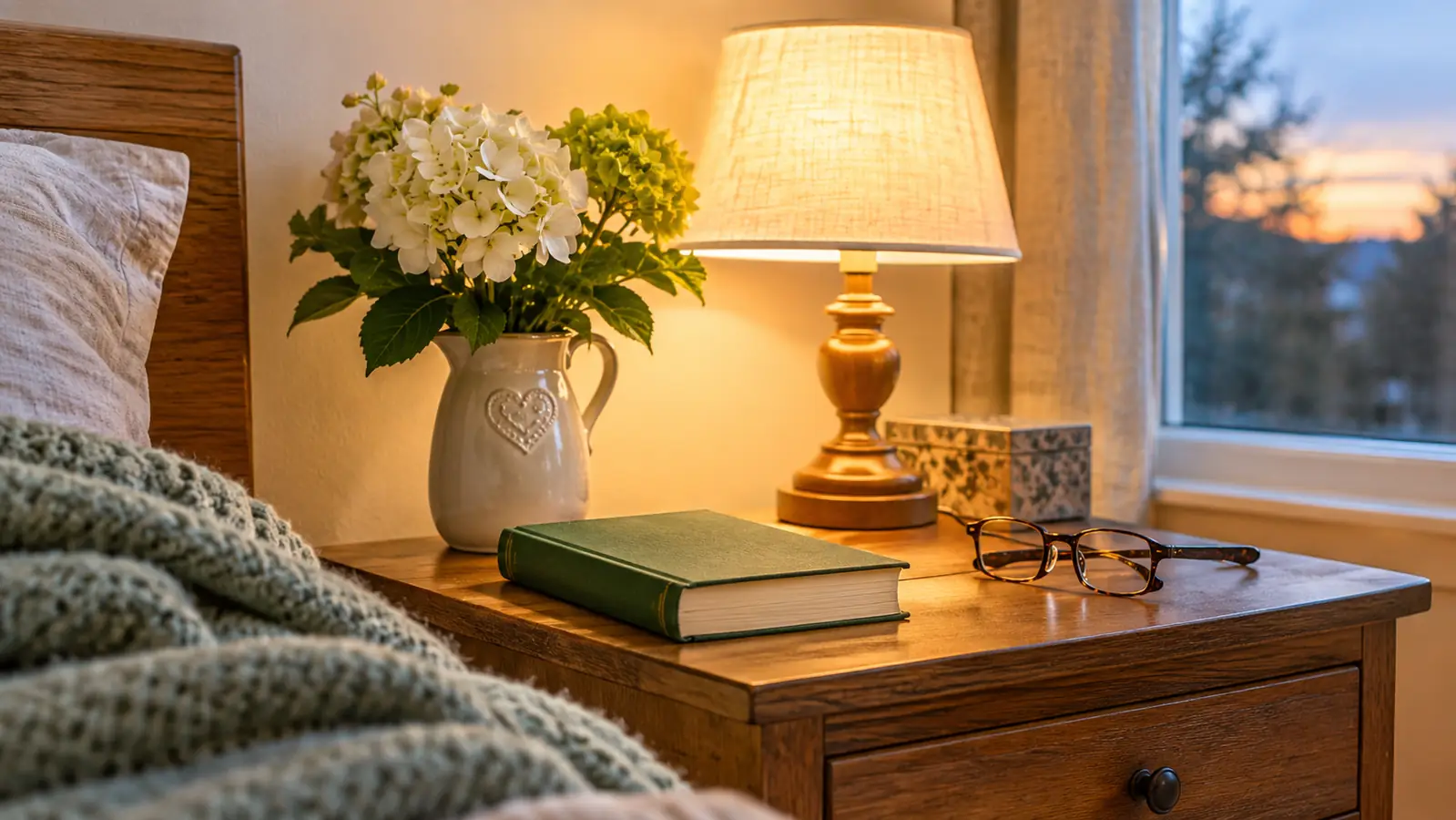
The copy I gave Walt is now a couple of years old. The corner has gone soft where his thumb goes. The clear plastic jacket is still on it and slightly cloudy, and I keep meaning to take it off and then not doing it. The binding has held. No pages have come loose, and this is a book that travels from the bedroom to the porch and back most weeks of the year. It is a cardboard cover, not leather, so it will look handled. That seems right for the object.
The plastic jacket is the one design choice I would argue with. It protects the cover and it collects fingerprints in roughly equal measure. You can take it off, and in my opinion the book looks plainer and better for it. Do not expect it to stay crisp if the thing is actually being read, and I would much rather it be read than kept crisp.
What It Is Not
It is not a scrapbook. It is sentences on paper, and if your plan involves a photograph of the two of you taped to the first page, plan to hand that over separately. Nobody at Knock Knock is pretending otherwise, but the small hardcover shape makes it look like it might be more of an object than it is. Set your expectations at a book of sentences and you will be pleased. Set them at a keepsake box and you will be puzzled.
It is not a journal for the person receiving it. They do not write in it. Everything inside comes from you, which makes the book a monologue rather than a conversation. Some people find that one-sided and say so. I think it is the entire point, and I have never once heard a recipient complain about getting fifty uninterrupted sentences from somebody who usually says three.
It is also not long. Fifty prompts and 112 pages sounds like a substantial object, but the whole thing reads in under an hour. The weight is in the writing, not in the reading. Go in knowing that, and you will not feel shortchanged when your person finishes the entire book in one sitting on the porch and then starts again from the front.
What I Liked
- Fifty prompts mean you are never staring at a blank page
- Small enough at 4.5 by 3.25 inches and 3.2 ounces to hand over with a card
- A hardcover with 112 pages, so it gets reread instead of shelved
- Leaves room to be as mushy, racy, or dry as you actually are
- Takes about ninety minutes of real writing, which is the part that gets remembered
Where It Falls Short
- Arrives blank and stays blank if you do not do the work
- Short lines; long-winded writers run out of room by page eighty
- All fifty prompts are fixed, and a few will not fit your relationship
- The clear plastic jacket smudges and clouds over a couple of years
- Not a scrapbook, so there is nowhere to put a photograph
Who This Is For
It suits a partner who reads. It suits the person who says they do not need anything, because it is not really an object so much as a thing you did. It suits an anniversary that is eleven days away and you have nothing. It suits a parent who wants to hand a grown child something that will not end up in a closet. Knock Knock has been printing this format for years and it has barely changed, which tells you the shape is right.
It travels well, too. At 4.5 by 3.25 inches and 3.2 ounces it slips into a handbag, a suitcase, or a padded envelope if the person you love lives three states away. That sounds like a small thing until the week you need it and every other gift you considered turns out to be fragile, oversized, or impossible to mail without a trip to the post office.
Who Should Skip It
Skip it if you are not going to write in it. That is most of the list, honestly. Skip it if you want a gift that arrives finished, or if the person you are buying for does not read, or if a blank line makes you physically uncomfortable. Skip it for a brand-new relationship, where fifty very specific prompts would feel like a mortgage application. And skip it if a page of handwriting is a genuine hardship, because there is no abbreviated version of this. Half a book is a half-finished gift and everyone can tell.
The Blank Lines Are The Whole Gift
Fifty prompts, 112 pages, 4.5 by 3.25 inches. Small enough for a bedside table, heavy enough to be read more than once. It only needs your handwriting in it.
Amazon Check Today's Price on Amazon →